How to Play!

IntroductionGameplayThe CardsActionsGame ModesCards: Appendix

Introduction

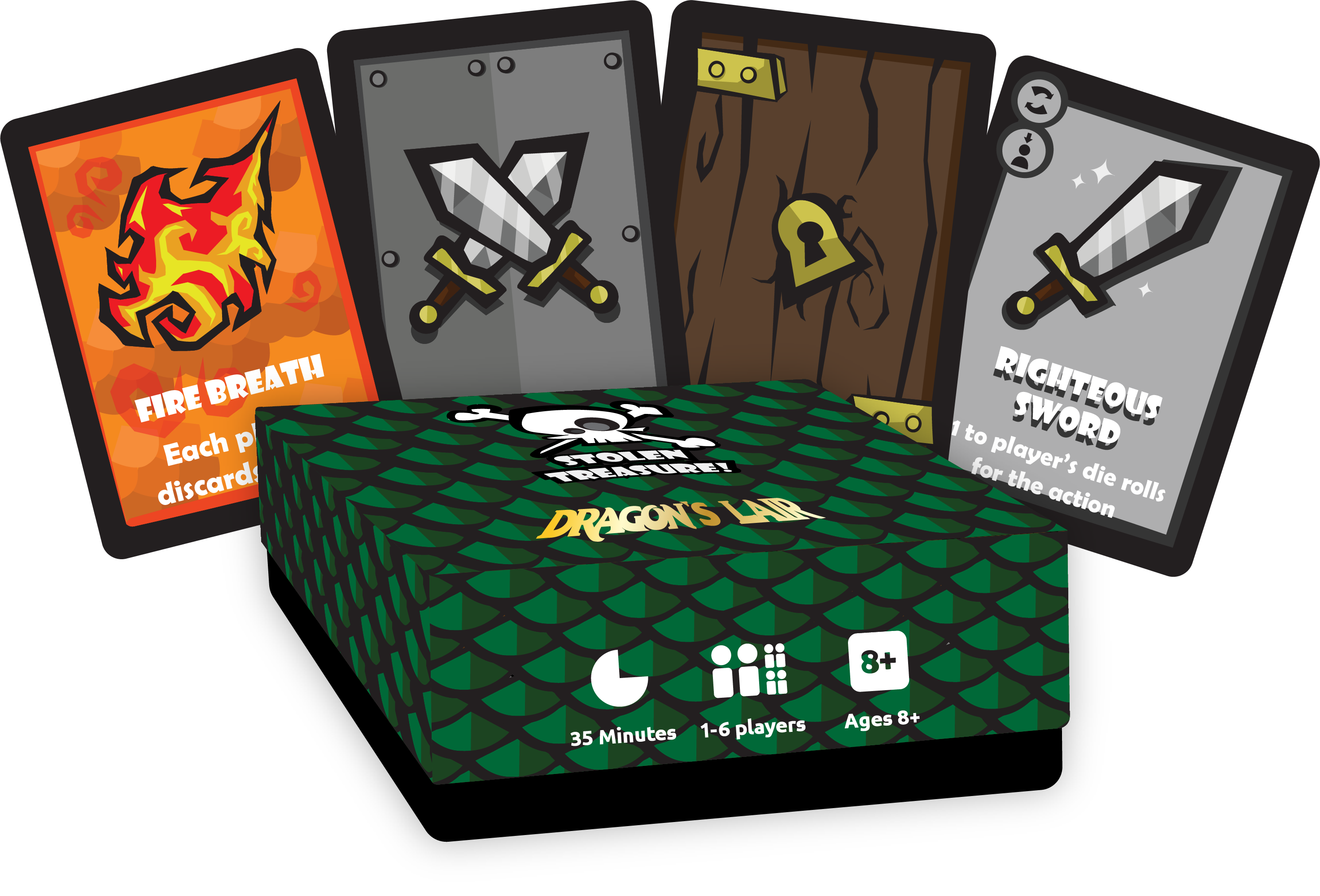
Dragon’s Lair is a fast-paced adventure of courage and wit. You and up to 5 other adventurers sally forth to plunder the treasure laden den of the fearsome DRAGON! Will it be a collaborative effort? Or will it be each adventurer for themselves? Just know one thing: the DRAGON does not appreciate its hoard being touched! And it won't be waiting idle!

Gameplay

Premise

Dragon's Lair is a card and dice game for 1 to 6 players. There are 4 modes of play: Solo, collaborative, competitive and asymmetric. In each mode you face the presence of the mighty DRAGON in a race to reach 1500 points of treasure.

Aim of the game

You are an intrepid adventurer, seeking fortune and glory. Your aim is to collect the 1500 points of treasure before the DRAGON collects it in their hoard.

Set Up

Separate the Dragon, treasure and item cards into their respective decks. Shuffle the separate decks then place them face down in the center of play. For the treasure cards, cut the deck in half and use both decks for play.

Taking a turn

During a turn, a player can perform TWO actions. The actions that can be taken are DRAWING or WAGERING. Only Two actions can be taken per turn. Any combination of valid actions can be performed during the turn. Eg. draw + draw, draw + wager, wager + draw, wager + wager.

Gameflow

Starting with the highest roller, take turns in a clockwise direction. Play continues in such fashion until one player or the DRAGON has reached the winning condition. If any of the Dragon, item or treasure card decks run out before the winning condition is met, shuffle any discarded cards back in to the decks and resume play.

Winning the game

A player or the DRAGON wins when they score 1500 points. Points are calculated as the total of the denominations on each treasure card in a player’s inventory. Once a player (or team) reaches the winning condition, this player(s) wins the game and gameplay is reset.

If the DRAGON’s hoard reaches the winning condition before the player(s), the game ends and gameplay is reset.

The Dragon

The fearsome DRAGON is an *automated opponent.

How the DRAGON works: The DRAGON is the major antagonist of the player(s) throughout the game. The DRAGON has its own hoard (equivalent to player’s inventory) and is engaged in encounters or wagers.

Any player not currently taking their turn can perform the DRAGON’s actions on its behalf.

*see asymmetric play.

Encountering the Dragon

Whenever a treasure card is drawn, an encounter ensues. At the start of an encounter the DRAGON draws and reveals cards from the Dragon card deck. The number of Dragon cards drawn is equal to the danger level (bottom left number) of the treasure card.

After all Dragon card effects are resolved, a contest of the treasure card begins. During a contest both player and the DRAGON roll 1 (unless otherwise stated by a card’s effect.) die each. The highest rolled value (after applying any card effects) will receive the treasure card for their inventory/hoard. 

If the rolled value of the RAGON and player are equal, all dice are rerolled until a winning roll is reached.

The Encounter

Is triggered whenever a treasure card is drawn. An encounter has two stages. 

Stage 1: Draw and resolve Dragon cards. 

Stage 2: Contest the treasure card. The contest is won by rolling the dice. Treasure goes to the winner of the contest.

Inventory/Hoard

Instead of a hand, players and the DRAGON have an inventory/hoard. Any treasure or item card acquired is placed face up on the table in front of them. Cards in an inventory/hoard belong to their respective player/DRAGON.

Items can only be used by the player whose inventory the card is in. (Unless otherwise stated by a card’s effect). 

A player can have a maximum of 3 items in their inventory. The DRAGON can have any number of items in its hoard. The players and DRAGON can have any number of treasure cards in their inventory/hoard.

The Cards

Treasure Cards

Treasure cards are placed in your inventory when collected. Treasure cards have a denomination (bottom right value) that contributes to a player or DRAGON’s winning condition score. A treasure card can be wagered. 

Treasure cards come in 3 different rarities: bronze, silver and gold. The rarity is demarcated by the artwork colour detail on the back of the cards. Generally, the denomination of the treasure card correlates to their rarity. Eg bronze lower value and gold higher.

The danger level of a card marks how many Dragon cards will be drawn in an encounter or how much bonus value the DRAGON will receive in a wager.

The rarity of a treasure determines the danger level (bottom left value) of the card. 

Rule of thumb:
Bronze danger level = 1
Silver danger level = 2
Gold danger level = 3

Dragon Cards

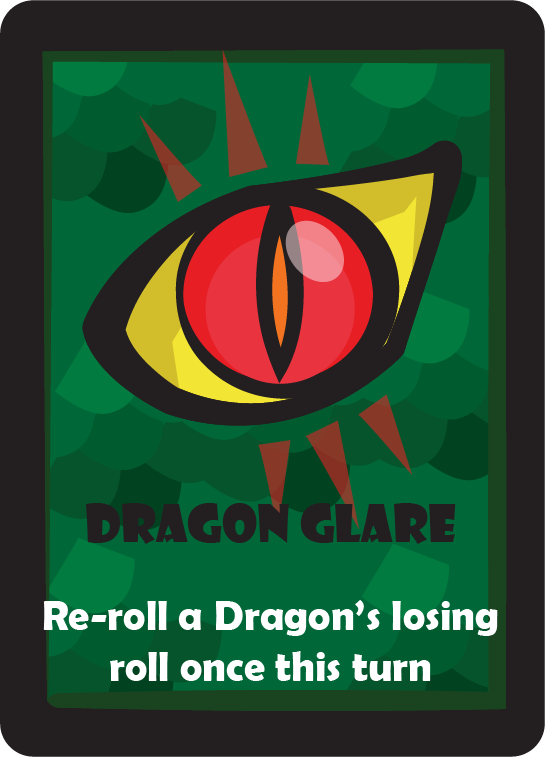
Dragon cards are drawn during an encounter before the contest. Dragon cards have various effects that will hinder a player’s attempt to collect treasure cards. The number of Dragon cards drawn in an encounter is equal to the danger level of the treasure card drawn.

When a Dragon card is drawn, the effect must be resolved/discarded before the next one is revealed. Dragon cards can affect the player in the encounter, all players, or the DRAGON itself. Once a Dragon card’s effect has been resolved it is discarded.

Players may respond to Dragon cards with items or card effects. If a Dragon card has the (!) icon, its effect is resolved before any other cards.

Players cannot draw cards from the Dragon deck.

Item Cards

For the player: Items can be used to help sway the odds of a contest in the player’s favour. Each player can have up to 3 item cards in their inventory. Once 3 item cards are in a player’s inventory, new item cards cannot be drawn or acquired by the player.

Using an item is NOT an action. Items can be used at any time during a player’s turn. Some items can be used out of turn reactively in response to other cards or items.

To use items
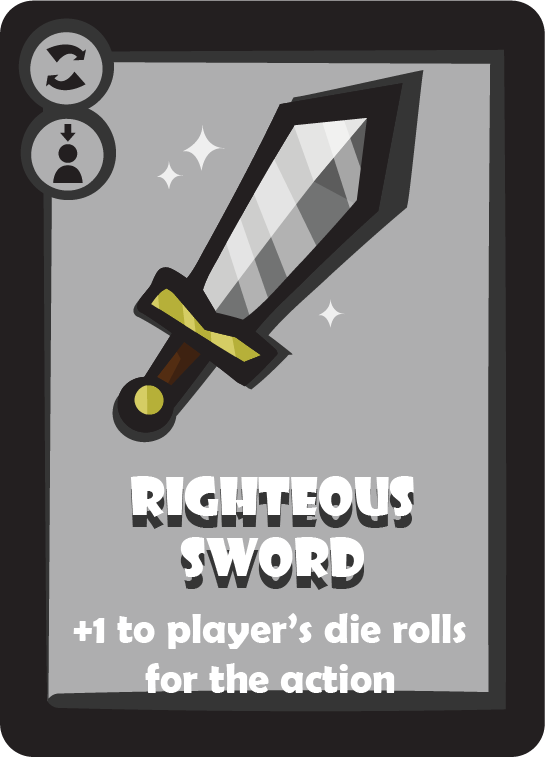
Item card effects are used by ‘tapping’ the card. Rotate a card 90 degrees to signify the item has been tapped. The effect of the item card is then resolved. Items that have been tapped cannot be used again until untapped.

At the start of a player’s turn they untap all items in their inventory.

For the DRAGON: If the DRAGON obtains an item card in its hoard, the item becomes a treasure card with a value of +100. Item cards in the DRAGON’s hoard cannot be used by the DRAGON or players.

Actions

Two actions per turn!

Drawing

The player picks up 1 card from the top of treasure or item card decks and reveals it to the table. Drawing is considered 1 action.

When drawing from the treasure card deck(s): place the treasure face up in the middle of the table. This initiates an encounter with the DRAGON. The card is then moved face up to the inventory/hoard of the contest winner. The denomination value of the treasure card counts towards the owner’s score immediately upon acquisition.

When drawing from the item card deck: item card is placed face up and untapped in the player’s inventory. 

Wagering

When wagering: Players can stake treasures from their inventory against the DRAGON or other players in a winner takes all contest.

To initiate a wager, a player places any number of treasure cards for their inventory into the middle of the table. The wagering player then declares a chosen opponent. This can be the DRAGON or another player. The chosen opponent places treasure cards face up onto the table with a total value equal to or the closest exceeding value to the originally wagered value.

The wager is resolved with a contest. The winner of the die roll then takes all staked treasure and puts it in their inventory.

When wagering a PLAYER: All items MUST be used at the start of the contest, prior to the roll of the dice.

When wagering the DRAGON: The wagering player can choose which of the DRAGON’s treasure cards they are staking, so long as it fires the equal (or closest exceeding) value condition. When wagering the DRAGON, items can be used at any point of the contest.

Notes:
• There is no limit to how many treasures can be wagered at a time.
• Treasure cards with negative denominations can be wagered.
• The chosen opponent of a wager cannot refuse the wager.
• If the chosen opponent cannot match the wagered amount, they must stake the highest closest value.
• Players/DRAGON with no treasure cards cannot be targeted by a wager.
• Wagers can only be initiated with treasure cards. Item cards cannot be wagered between players.
• A player cannot win an extra item card in a wager if they already have 3 items. If a player wins an item card with a full inventory, they must discard one item.
• Only players can initiate wagers.

Game Modes

Solo-mode (1 player)

When playing alone your win condition remains the same. Instead of taking a turn, perform actions until yours or the DRAGON’s winning condition is met.

Collaborative (2-6 or more players)

When playing collectively with 2 or more players the win condition remains the same, however you play as a team. Treasure across ALL player inventories are added together for the winning score. All players win if they collectively reach the winning condition before the DRAGON.

Treasure and items are still kept in their respective player’s inventory, only the score value is shared. (A player cannot use their teammate’s items or wager a teammate’s treasure.)

Competitive (2-6 or more players)

When playing competitively the FIRST player to reach the target score wins. Each player’s inventory contributes solely to their score. If the DRAGON reaches the winning condition first, no players win.

‍Note: The 1500 point condition is the target for a balanced game with 4 people. For more than 4 players, try a 1200 point target for players, keeping 1500 points for the DRAGON. Alternatively, a different win condition can be set upon agreement by all players before gameplay starts. Gametime can also be modulated in this fashion, with games taking longer the higher the target winning target score.

Asymmetric (2-6 or more players)

When playing with asymmetric mode ONE player will play as the DRAGON. All other player(s) are adventurers. The winning player is theone who reaches the target score first.

How to play as the DRAGON: At the start of play, the DRAGON player draws a hand of 5 Dragon cards. Replenish this hand to 5 cards at the end of each player and DRAGON player’s turn. On the DRAGON player’s turn they may perform 1 action.

Dragon Actions:

• Draw: Can draw 1 card from the DRAGON or treasure deck. The DRAGON player can have more than 5 Dragon cards in their hand in this manner. When a treasure card is drawn by the DRAGON player, it goes directly into their hoard. No encounter is initiated.
• Dragon card: The DRAGON player may choose to play a Dragon card from their hand. Playing and resolving the Dragon card’s effect counts as 1 singular action.

Appendix: Card Icons

The appendix section goes into detail how to play each of the Dragon, treasure and item cards. Targets and Timing icons are introduced below to quickly highlight the usage of Dragon and item cards.

Targets

The targeting icon signals which players the item and Dragon card affect.

Single Opponent

Dragon card targets a single player.

All Opponents

The effect of the Dragon card affects all players.

Self Targeted

The effect of the item card will apply to the player.

Everyone

The item card can be used out of turn. For the owning player or other players.

Timing

The timing icon signals when the player can play a piracy card.

Single Use Item

This item can be used once then must be discarded.

Interrupt

This card's effect must be resolved immediately. Before any other effects.

Re-useable Item

This item can be used multiple times. The card is 'tapped' to use.

Dragon Effect

This card's effect is for the dragon.

Card List

Click on each card for more details!

The targeting icon signals which players the piracy card affects.


Dragon Cards


Item Cards


Treasure Cards